I never thought I’d be the type to spend a snowy December afternoon spreading lime on a digital field. But here I am, in late 2026, still returning to Farming Simulator 22 like it’s a cozy blanket for my gamer soul. Five years ago, I was busy chasing battle passes and K/D ratios. Then a friend told me to try this “boring” farm game. I laughed. I installed. I got hooked—not by explosions, but by the quiet satisfaction of a perfectly straight harvest line. What I didn’t realize back then was that I was part of a phenomenon. A phenomenon that would make industry analysts scratch their heads and triple-A studios blush.
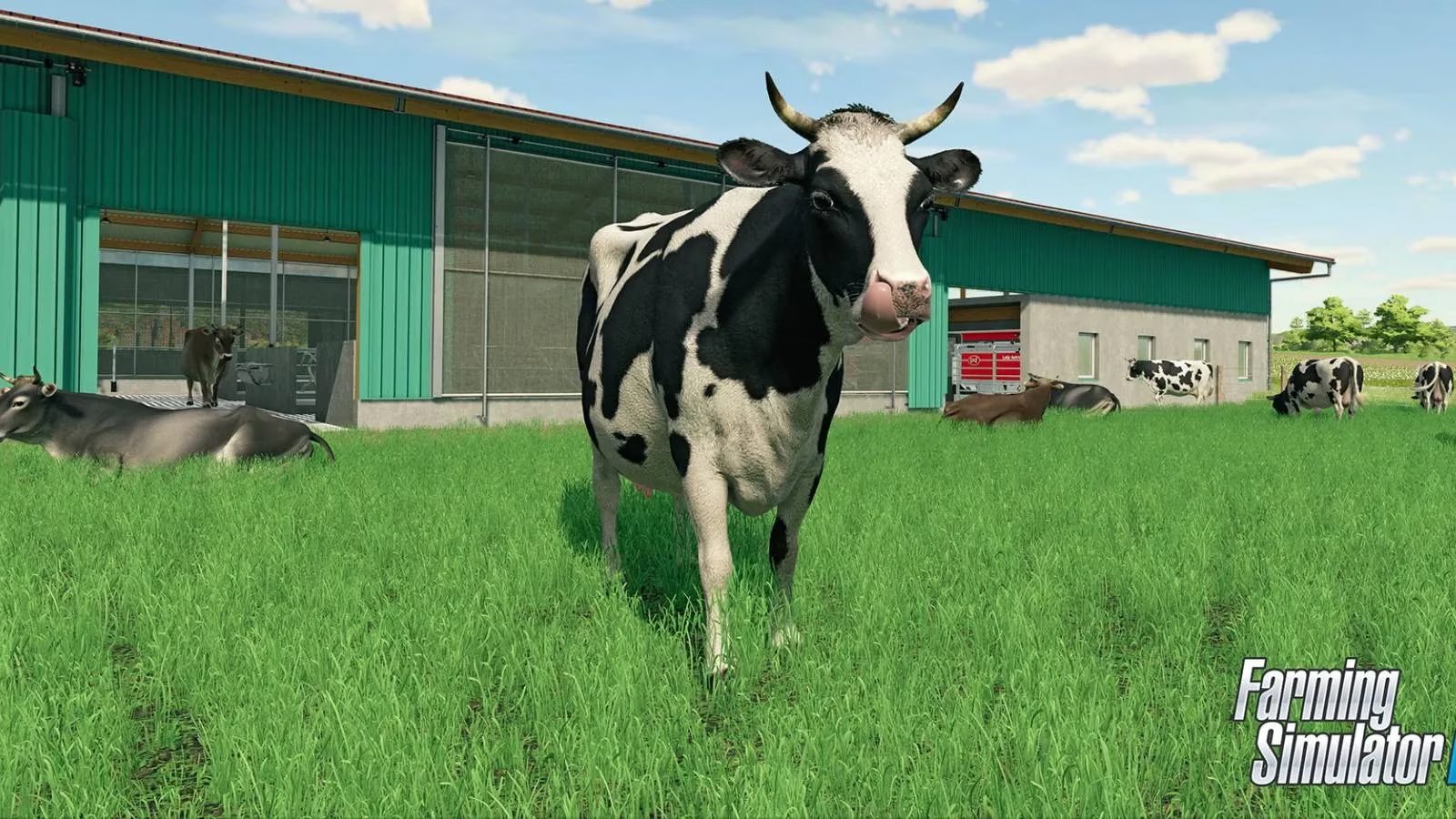
Back in December 2021, when the game had just launched, I remember scrolling through GamesIndustry.biz and seeing Christopher Dring’s jaw-dropping stats. Farming Simulator 22 had outsold some of the year’s biggest releases in Europe. And I don’t mean indie darlings—we’re talking about The Legend of Zelda: Skyward Sword HD, Ratchet & Clank: Rift Apart, Monster Hunter Rise, Forza Horizon 5, and Guardians of the Galaxy. Let that sink in. A game about tractors, crop rotation, and cow suction devices crushed titles with nine-figure budgets and decades of nostalgia. I felt a strange pride, like my secret hobby had suddenly been validated.
The numbers kept getting wilder. Within its first week, Farming Simulator 22 sold 1.5 million copies. To put that in perspective, it beat Battlefield 2042 in both sales and peak player count on Steam. Battlefield! The franchise that once defined online shooters! And the reviews? Night and day. While Battlefield stumbled through launch with bugs and backlash, Farming Simulator 22 rolled out smoothly, earning praise for its depth, accessibility, and bizarrely hypnotic gameplay. I vividly remember forum threads where Battlefield refugees confessed they’d traded jets for John Deeres. It was the great migration nobody predicted.
So what does this say about European gamers? Some joked that Europeans are less violent, more into chill, casual experiences about hooking up cows to milking machines. Others mused that maybe they’d rather feed the world than destroy it. The truth? I think it’s about pace. There’s a rhythm to Farming Simulator that modern blockbusters often lack. You plant, you tend, you harvest. There’s no pressure to hit a headshot in 0.2 seconds or memorize a 40-button combo. You just exist in a world where the loudest sound is a tractor engine purring. For me, after a day of work in 2026, that’s exactly what I crave.
But don’t confuse “chill” with “uncompetitive.” Oh no. The European Farming Simulator esports league proved that. Even back in 2021, the best virtual farmers gathered to see who could bale hay and harvest crops with machine-like precision. The tournament had a €100,000 prize pool, and I tuned in just to see if it was a joke. It wasn’t. The focus, the strategy, the clutch maneuvers in a field of wheat—it was surprisingly intense. By 2026, that league has evolved into a continent-wide spectacle with a prize purse exceeding €500,000. Stadiums fill with fans wearing team jerseys, and minor league competitions feed the majors. I now follow a team, Green Acres Elite, the same way my dad follows football. Who needs rocket league when you have real-time soil management derbies?
Other stats from 2021 look almost quaint now. The Nintendo Switch dominated hardware sales across Europe—a trend that continues into 2026 with the Switch’s successor still flying off shelves. It Takes Two was named the year’s best new game, a co-op masterpiece that proved creativity still thrives. And FIFA 22, unsurprisingly, remained the number one selling game across every European territory. Yet Farming Simulator 22’s quiet ascent felt more meaningful. It wasn’t the giant; it was the giant slayer.
Five years later, I still boot up Farming Simulator 22. Sure, Farming Simulator 25 released in 2024 and added dynamic weather disasters and drone crop dusting, but the modding community for FS22 is legendary. Thousands of mods have turned my farm into a sprawling empire with custom machinery, new maps, and economic systems that could teach Wall Street a thing or two. The game’s bones were so solid that even developer Giants Software keeps supporting it with surprise updates. Just last month, they dropped a nostalgia pack with vintage tractors from the 1960s. I spent three hours just tuning them up.
Looking back, the success of Farming Simulator 22 taught me something about the gaming world—and about myself. We often chase the next adrenaline spike, the photorealistic shooter, the cinematic RPG. But sometimes joy hides in a quiet lane, behind a plow, under a sky that needs no dragon to be interesting. It’s not about escaping to a fantasy world; it’s about growing one.
So as December 2026 wraps its cold arms around me, I’ll be in my virtual barn, checking my silage levels and planning next season’s soybean rotation. Maybe I’ll finally break into the esports amateur league (I hear the qualifying rounds are broadcast on FarmTV). Or maybe I’ll just drive my tractor to the top of a hill, watch the sunset, and think about how a game about farming became my game of the decade. Thank you, Farming Simulator 22. May your harvests forever be bountiful. 🚜🌾