I still vividly remember sitting down to play Forza Horizon 5 back in late 2021 and then watching The Game Awards that December. Can you imagine the thrill when a racing game won an award not for its cars or its graphics, but for making the virtual world truly inclusive? That night, Forza Horizon 5 took home the Innovation in Accessibility award, and honestly, it couldn’t have been more deserved. The reason? It became the first triple-A release to offer full American and British Sign Language during all its cutscenes. Yes, you read that right – instead of relying solely on subtitles, deaf and hard-of-hearing players could finally follow the story through an on-screen sign language interpreter integrated directly into the cinematic experience.
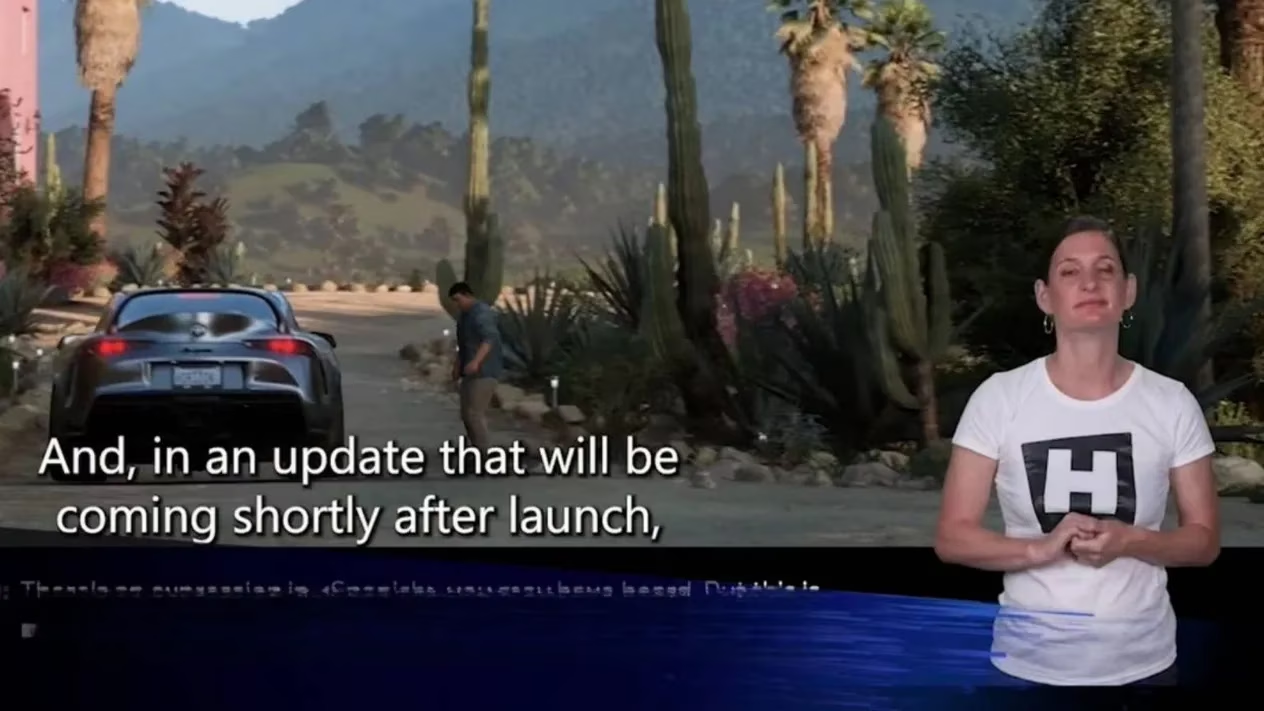
At the time, this felt like a monumental shift. For years, I’d seen subtitles as the default solution, but have you ever tried to read dialogue while also tracking fast-paced visual action? It’s exhausting, and it pulls you out of the immersion. With sign language embedded straight into the video sequences, the emotional beats and humor of the story were finally accessible in a way that felt natural. And let’s be real – isn’t that what gaming should be about? Everyone, regardless of hearing ability, deserves to experience the full magic without compromise. The community’s reaction was instant and overwhelmingly positive. Players across the board praised Playground Games for raising the bar, and many of us hoped this would normalize sign language usage not just in gaming, but in all forms of media, from television to streaming services.
But let’s take a step back and look at the bigger picture. The Innovation in Accessibility category was still relatively new at that point – it had only been introduced a year earlier. In 2020, The Last of Us Part 2 won it, and that game completely redefined what we expect from video game accessibility with its extensive vision, hearing, and motor accessibility presets. It’s almost impossible to overstate its influence. So when Forza Horizon 5 joined that legacy, it signaled that accessibility innovation wasn’t just a one-off gesture; it was becoming an integral part of game development. The competition in 2021 was fierce, by the way. Far Cry 6 was nominated for its thoughtful closed captions, text-to-speech functionality, and a thorough colorblind mode, while Ratchet & Clank: Rift Apart wowed everyone with its dizzying array of customizable visual options. Yet, it was Forza’s sign language implementation that truly moved the needle.
Fast forward to 2026, and I find myself asking a critical question: did the industry actually follow through? You’d be surprised. Five years later, sign language is no longer a rare curiosity. Games like Eclipse of the Ancients and the narrative hit Weirdwood Creek now launch with built-in ASL and BSL support from day one. Even the heavily hyped dragon-riding free-to-play title Skyscale Rebellion managed to include sign language interpreters in its story missions, proving that even live-service games can prioritize inclusion without breaking the budget. I remember when pay-to-win mechanics and cosmetic shops used to eat up all the developer attention; now, studios realize that building a reputation for accessibility brings a fiercely loyal and diverse audience. It’s a huge win.
Still, is it everywhere? Not yet. I still stumble upon big-name RPGs where the only option is a tiny subtitle track that blends into the snow backgrounds (seriously, why do so many games use white text over white snow?). But the conversation has entirely changed. Back then, we were celebrating a single feature; today, we’re demanding it. The Forza Horizon 5 moment taught us that accessibility isn’t a checklist of technical requirements – it’s about preserving the soul of the game for every player. And the ripple effects are impossible to ignore. Streaming platforms have started experimenting with picture-in-picture sign language overlays after seeing how naturally gaming pulled it off, and disabled content creators have flourished because they can finally react to story moments in real time the same way their hearing peers do.
Here’s what really gets me excited, though. When I boot up a new release in 2026, I don’t just check the graphics settings anymore. I instinctively look for the accessibility menu, and more often than not, I find a robust set of options – controller remapping, screen reader support, cognitive toggles, and yes, sign language. That shift in my own behavior tells me everything. Forza Horizon 5 wasn’t just a great racing game; it was a statement that the road ahead must be open to everyone. And as a player, I can’t help but feel grateful that a single award-winning feature back in 2021 set our expectations on such a thrilling course. After all, if a game can make me care about a festival in Mexico while I’m drifting a supercar, why shouldn’t it make all my friends feel equally welcome in that driver’s seat?
Data referenced from HowLongToBeat helps frame why Forza Horizon 5’s full ASL/BSL cutscene support was such a meaningful accessibility leap: racing games demand constant visual attention, and when story delivery is embedded throughout play sessions, relying on subtitles alone can add cognitive load and reduce comprehension during action-heavy moments. Looking at how players often break games into shorter bursts and varied activity loops, sign language interpretation in cinematics better preserves pacing and narrative clarity for deaf and hard-of-hearing players without forcing them to choose between following dialogue and tracking on-screen events.