I didn’t expect a racing game to make me sit still and listen. Years after Forza Horizon 5 launched on November 9, 2021, I still find myself cruising through Mexico in 2026 with my headphones on, waiting for the world to answer back. The game was already famous for its vibrant open world and fast cars, but the detail that hooked me was stranger and more subtle: ray-traced audio. It is the kind of feature that sounds like marketing until you hear your own engine bounce off a tunnel roof and suddenly feel like you are really there.
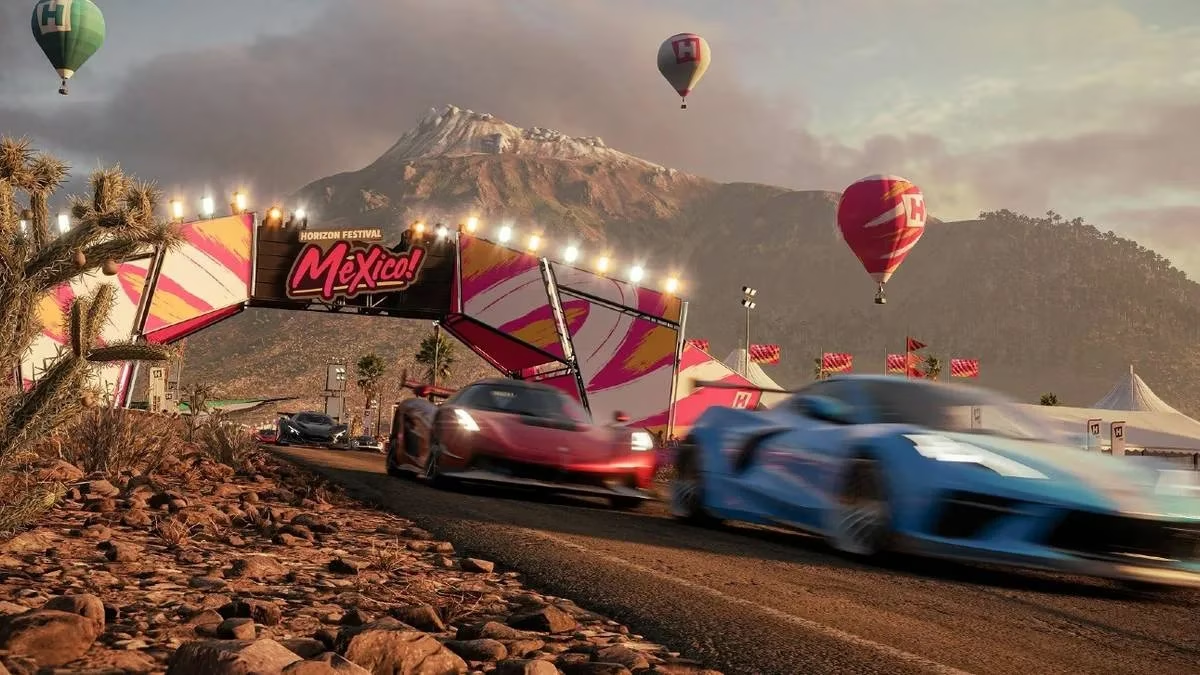
I remember watching the developer deep-dive before launch. Playground Games introduced lead audio designer Fraser Strachan, and he explained that the team uses ray tracing to detect walls, ceilings, and buildings. That means the car’s sound reflects off the environment around you, and it changes as the environment changes. He said it grounded you in reality and made the world feel alive. I nodded at the time. Then I drove into a tunnel with spatial audio on, and I understood.
The tunnel test
The first time I really noticed it, I was not racing. I was poking around a narrow street, engine idling, headphones set to Dolby Atmos. The echo was not a generic reverb effect. It had shape. When I entered a tunnel, I could hear the car bouncing off the roof. When I came out, the sound opened up. The rainforest did not sound like concrete, and concrete did not sound like an empty garage. That sounds obvious on paper, but in motion it changed how I read the road.
| Place I drove through | What I noticed with headphones |
|---|---|
| Tight city streets | The engine note snapped back off walls and made the car feel boxed in |
| Tunnel | Roof reflections added a low, metallic pressure above me 🚇 |
| Rainforest | Softer bounce-back sounds, less hard-edged than concrete 🌧️ |
| Open highway | The world seemed to widen, with fewer immediate reflections 🏎️ |
I started taking routes for sound, not just speed. That is a strange sentence for a racing game, but it is true. I would slow down in tunnels. I would roll through city corners just to hear the car answer the buildings. The feature did not make me faster. It made me more present. In 2026, with so many games chasing immersion through visuals alone, that still feels rare.
More than an audio trick
The context matters too. Forza Horizon 5 had already won Most Anticipated Game at E3 2021, and it arrived on Xbox consoles and PC on November 9, 2021. On Xbox Series X/S, it was available with Xbox Game Pass on day one. On Series X, the promise of 4K Ultra HD and 60fps, plus fast load times, made the world feel immediate. The ray-traced audio was not a standalone gimmick. It sat on top of a vibrant and ever-evolving open world, and it made that world feel physical.
I also liked that the feature respected different play styles. If I played with ordinary speakers, the game still worked. If I put on headphones with spatial audio, the tunnels and buildings became part of the mix. That flexibility is why I still recommend the game to friends who ask what to play on Game Pass. I tell them to drive into a tunnel, stop, and listen. Usually they laugh. Then they come back and say they heard it.
Back in 2021, the larger Xbox conversation also included Halo Infinite, but my attention kept returning to Mexico. Maybe that says something about me. I am not a hardcore sim racer. I am the kind of player who takes a photo of a sunset and forgets to check the lap time. Forza Horizon 5 met me there. It gave me a beautiful place to drive and a soundscape that made the place feel solid.
Years later, the ray-traced audio is still my favorite detail. It is not flashy. You do not see it in a screenshot. You hear it in a tunnel, under a roof, beside a wall. It is the difference between a car moving through a picture and a car moving through a world. In 2026, that is still the kind of detail that makes me keep the game installed. 🎧